Last updated on March 17, 2026
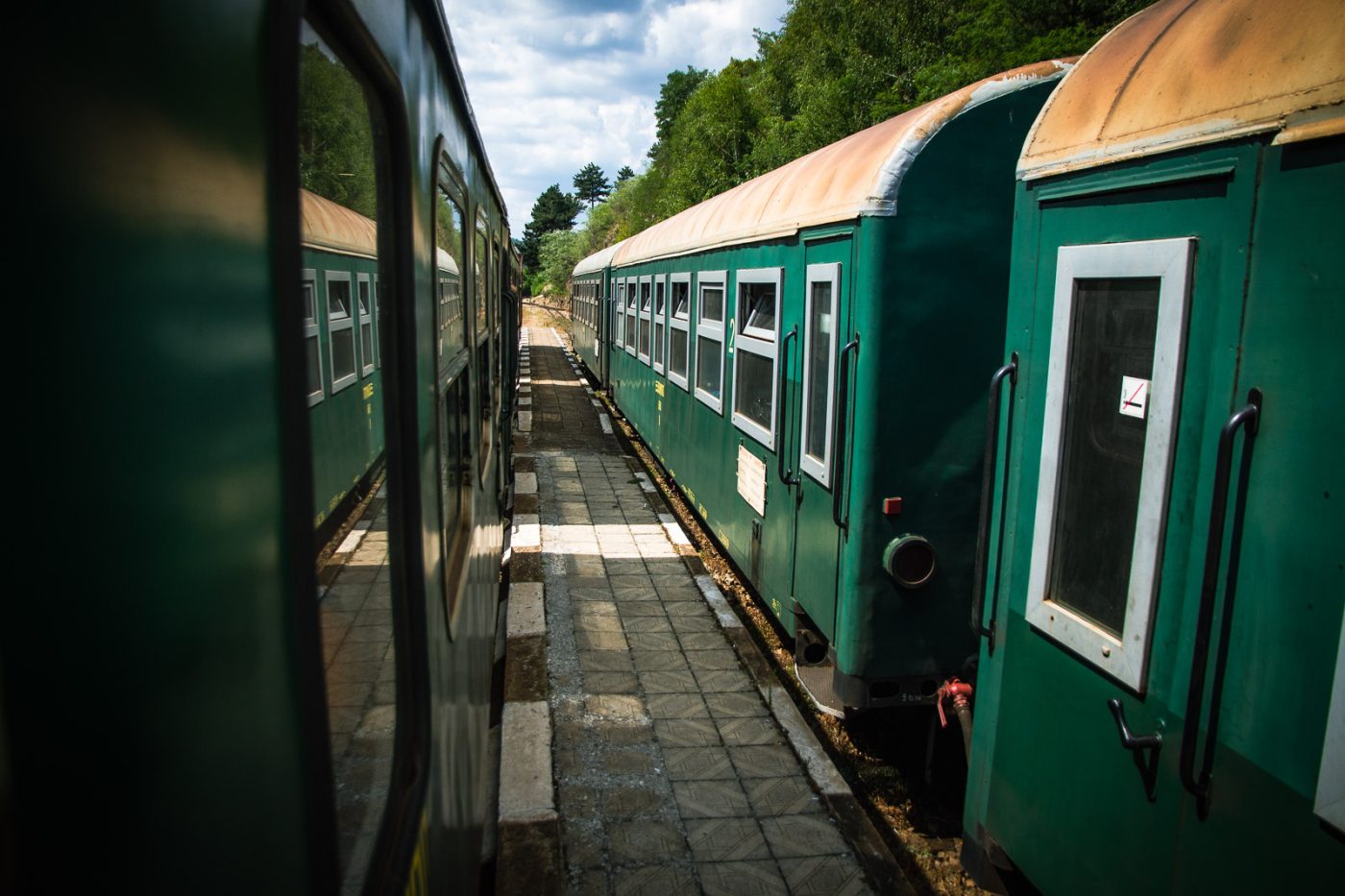
Types of Bulgarian trains and which one to choose
When using Bulgaria trains, the first thing to look at is surprisingly simple: is the train direct, or does it require changes?
This matters more than the official train category. The Bulgarian rail network is extensive, but connections are not always designed for smooth transfers. A route that looks efficient on paper can quickly turn into a long day of waiting on platforms.
Direct trains
If you have the option, choose a direct train.
Direct trains are usually the fastest and least stressful way to travel across the Bulgarian rail network. You board once, stay in your seat, and get off at your destination. No transfers, no guessing which platform you need next.
That said, “fast” in Bulgarian railways terms should be understood in context. Even the faster services are rarely comparable to Western European high-speed trains.
Still, avoiding transfers removes the main source of uncertainty in the system.
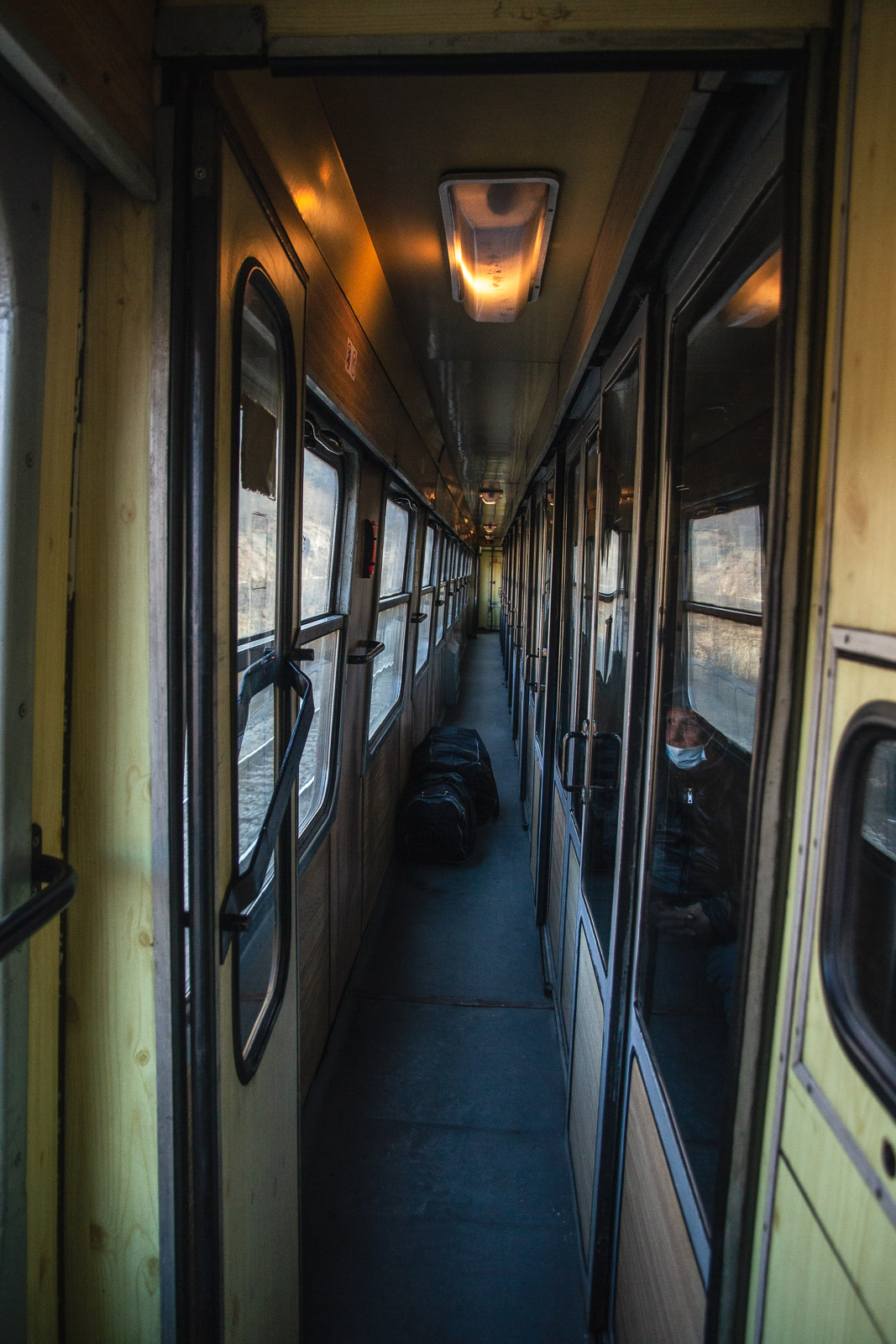
Trains with changes
Some routes in the Bulgaria rail network require changing trains along the way.
This means getting off one train and boarding another, often in smaller regional stations. Occasionally the connection works smoothly. Other times the timing is less forgiving.
If your first train runs late, the second one may wait – or it may leave without you. And if the connection time is long, you could be standing on a quiet rural platform for quite a while.
In summer that means heat.
In winter it means cold.
Sometimes the change does take you through places most travelers never see, which can be interesting if you’re not in a hurry. But if your goal is simply getting from A to B, direct trains are usually the better choice.
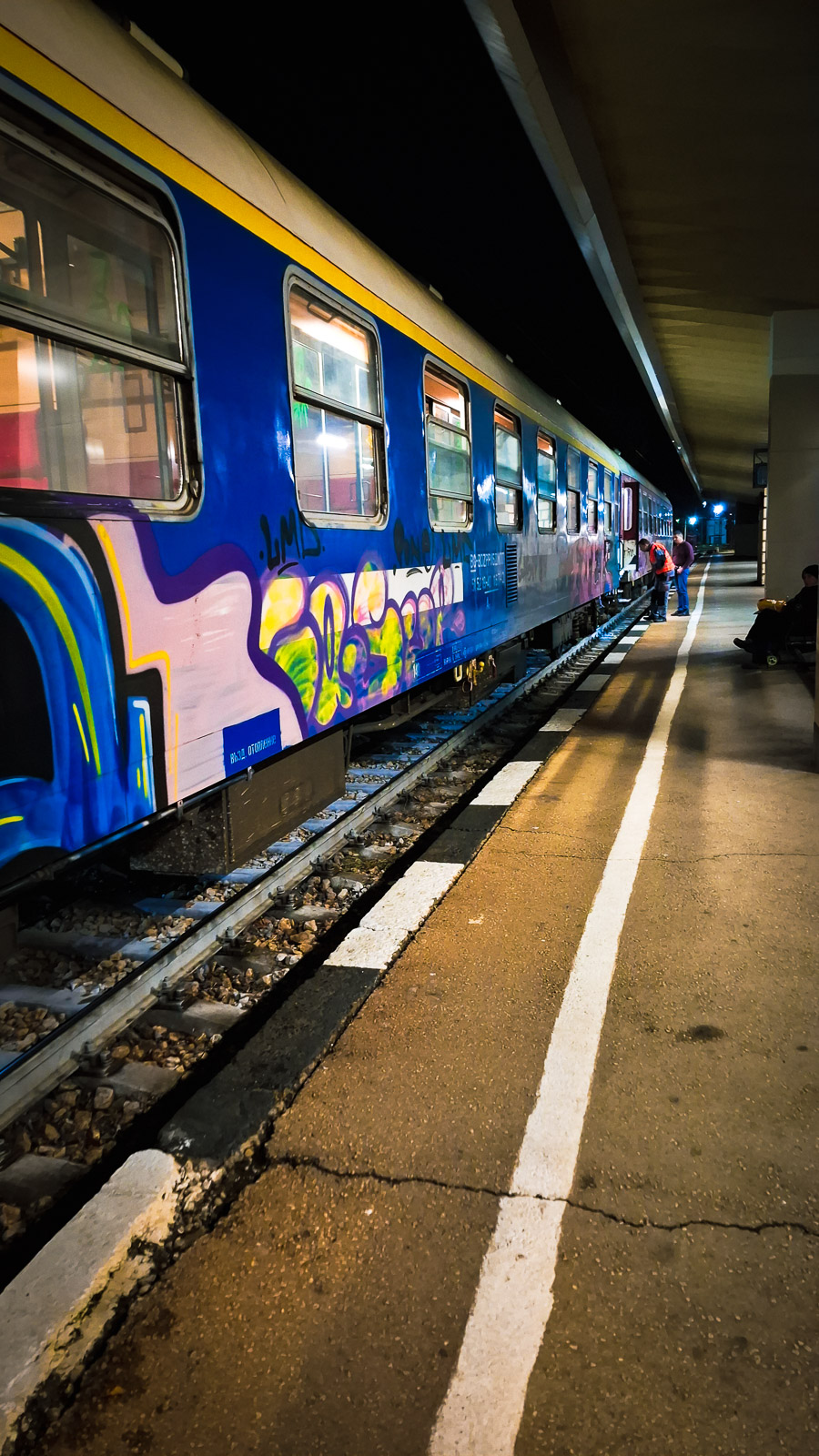
Bulgarian State Railways train types
On the official BDZ (Bulgarian State Railways) website, you’ll see a legend explaining different train categories and icons. The descriptions there are not always particularly clear, so here’s what travelers actually need to know.
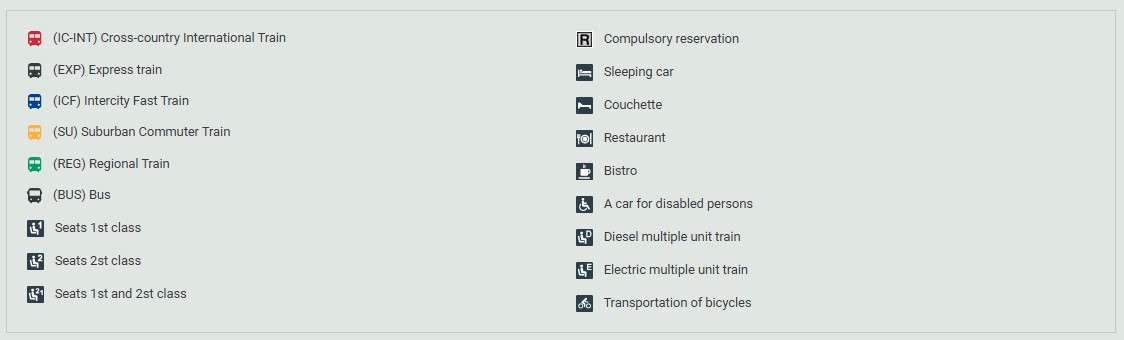
These are the main types of trains you’ll encounter when using Bulgaria trains:
- IC-INT (International trains) – these are cross-border services operated by Bulgarian Railways. Currently they connect Bulgaria with Bucharest (Romania) and Halkalı / Istanbul (Turkey).
- ICF (Intercity Fast trains) – They stop only at major stations and usually use slightly newer rolling stock (though “new” is a flexible concept here). A seat reservation is mandatory, typically adding around €0.50 to the ticket price.
- EXP (Express trains) – In practice, EXP trains no longer operate. Most of them have been replaced by ICF services.
- SU (Suburban trains) – Suburban (commuter) trains connect major cities with nearby towns and villages. They are designed mainly for daily commuting rather than long-distance travel. You’ll encounter them around larger cities like Sofia, Plovdiv, and Varna.
REG / ORD (Regional trains) – These are the most common trains on the Bulgaria rail network. Regional trains stop at almost every station along the line, which makes them slower but useful if you’re traveling to smaller towns that faster trains skip. If your destination is somewhere rural, there is a good chance you’ll end up on one of these.
Types of seats and classes on Bulgarian trains
Another way to understand Bulgaria trains is by the type of seating or sleeping arrangement available on board.
Most trains in the Bulgarian rail network are simple seated carriages, but on certain routes – especially longer journeys – you’ll also find sleeping compartments.
Here’s what the options usually look like:
- First class – First class is available only on certain trains and routes within Bulgarian Railways. The difference is not dramatic, but it’s noticeable. Seats are usually larger and more comfortable, and the carriages tend to be quieter and less crowded.
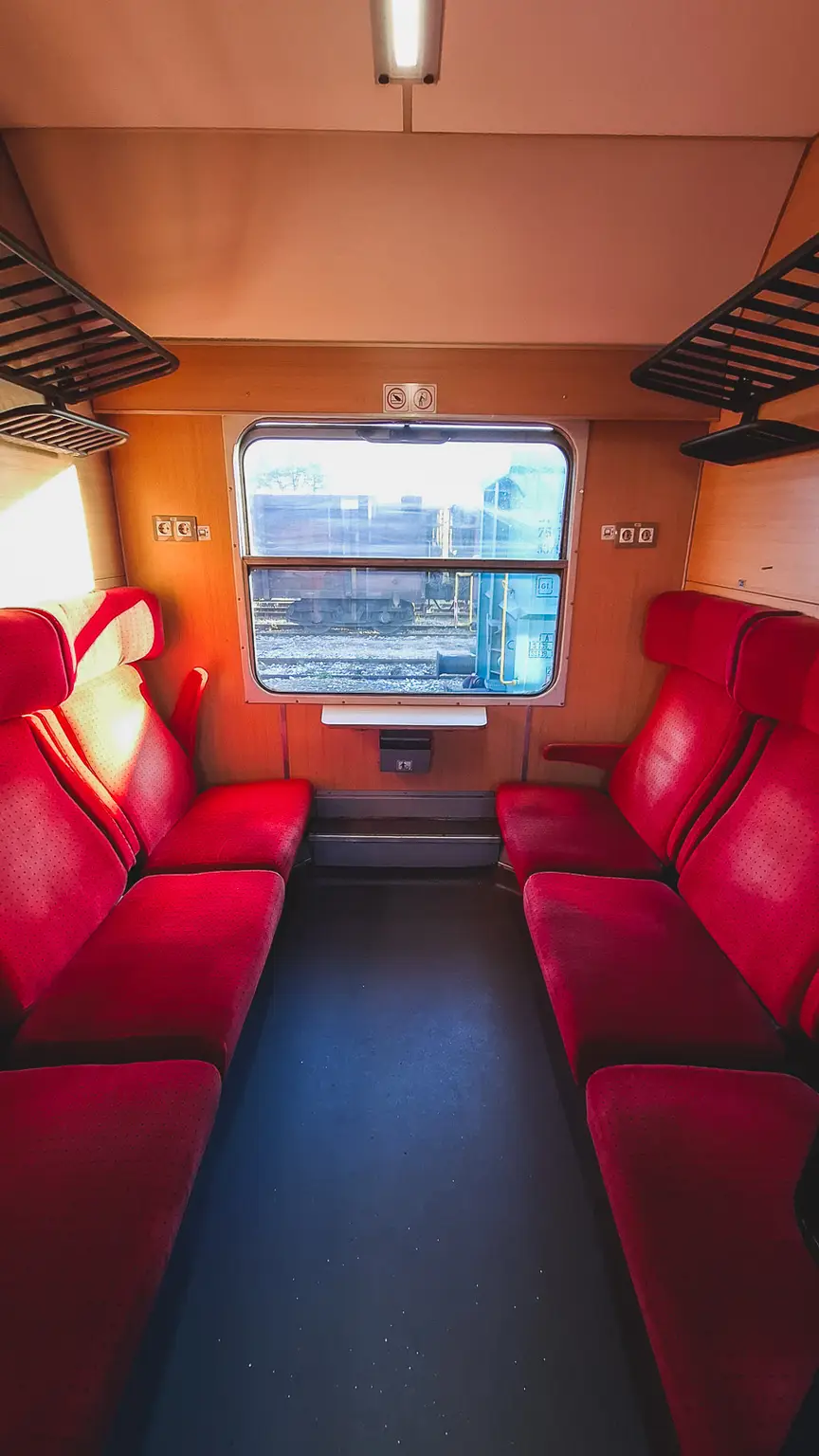
- Second class – Second class is the default option on most Bulgaria trains and by far the most common. These carriages are perfectly usable and widely available across the entire Bulgarian rail network, though comfort levels can vary depending on the age of the train. It’s part of the experience.
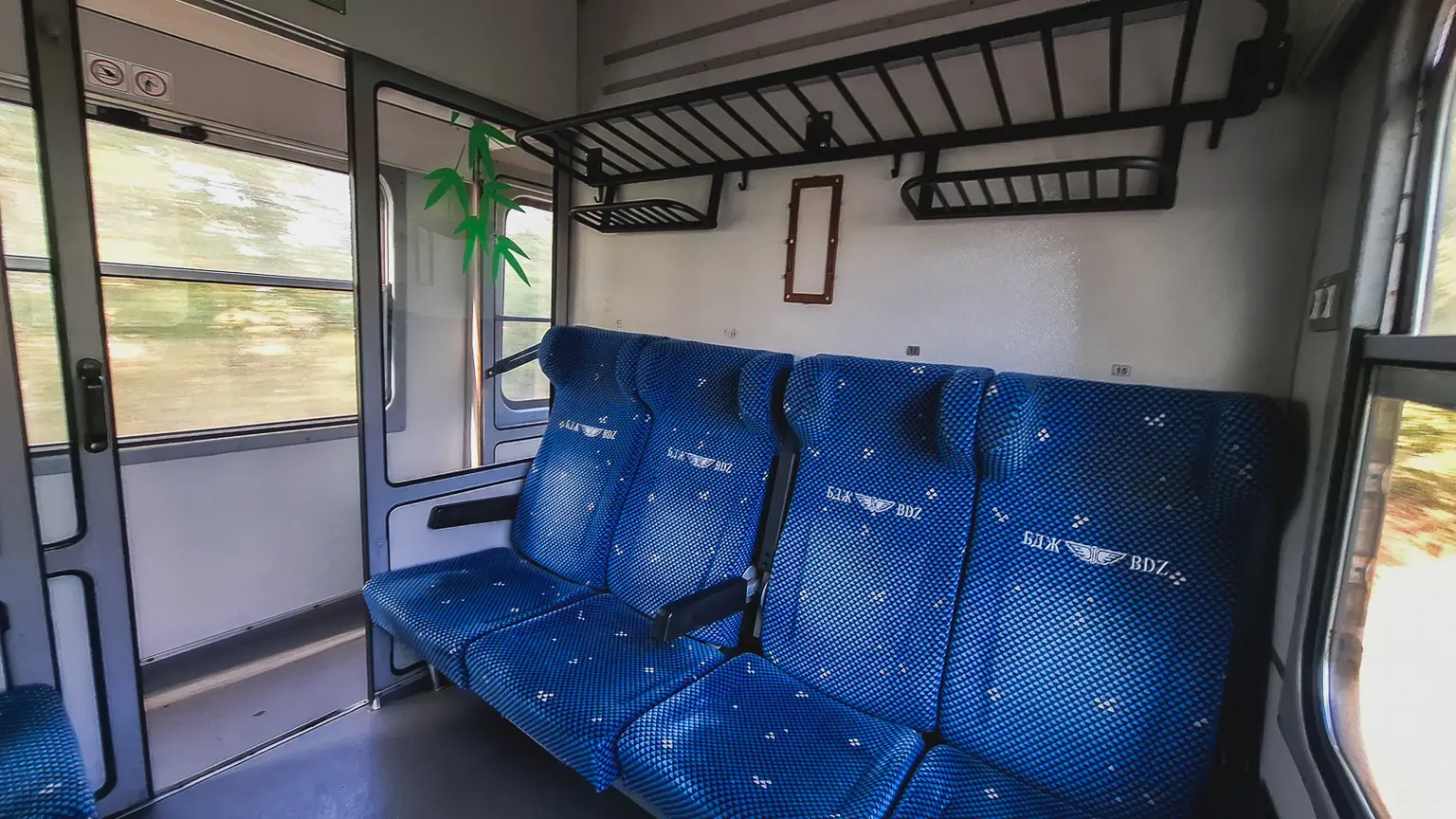
- Seat reservations – On some trains – especially ICF (Intercity Fast) services – seat reservations are mandatory. The reservation usually costs around €0.50 and is added to the ticket price.
- Sleeping car (berth) – Sleeping cars appear on some overnight Bulgaria trains, particularly on the Sofia – Burgas – Sofia and Sofia – Varna – Sofia routes. When booking online, this option is usually listed as a “berth.”
- Couchette – A couchette is the more basic version of a sleeping compartment. You’ll still get a horizontal bunk, but the setup is simpler and shared with more passengers.
Attraction trains
There is another category of Bulgaria trains that doesn’t appear in the official BDZ (Bulgarian State Railways) legend at all: attraction trains.
These are special trains used for tourist journeys, historical demonstrations, or occasional themed trips. They don’t operate on regular schedules and usually require separate booking or advance announcements from Bulgarian Railways.
At the moment, there are five attraction trains operating within the Bulgaria rail network:
- Rhodope Narrow Gauge Railway – The Rhodope Narrow Gauge Railway runs between Septemvri and Dobrinishte, crossing deep valleys and high mountain passes in the Rhodope Mountains. This is the last surviving narrow-gauge railway in Bulgaria, and it moves slowly enough that the landscape becomes part of the experience.
- Corona Express – The Corona Express consists of historic railcars built in Germany between 1938 and 1939 for the royal family of Bulgaria. These carriages were originally used for the official travels of Tsar Boris III, Tsarina Ioanna, and Prince Kiril.
- Vitosha Express – The Vitosha Express represents a different chapter of Bulgarian history. Built in Germany in 1975, this train composition was used by Todor Zhivkov, the long-time head of state during the socialist period.
- Steam locomotive trains – Several restored steam locomotive compositions are still operational in Bulgaria. Riding behind one of these engines is less about efficiency and more about atmosphere – the whistle, the coal smoke, and the slow rhythm of old rail travel.
- Diesel Train Unit 19 0001 – А restored retro train with both first- and second-class seating. Its most distinctive feature is the fully equipped bar, which changes the mood of the journey quite a bit.
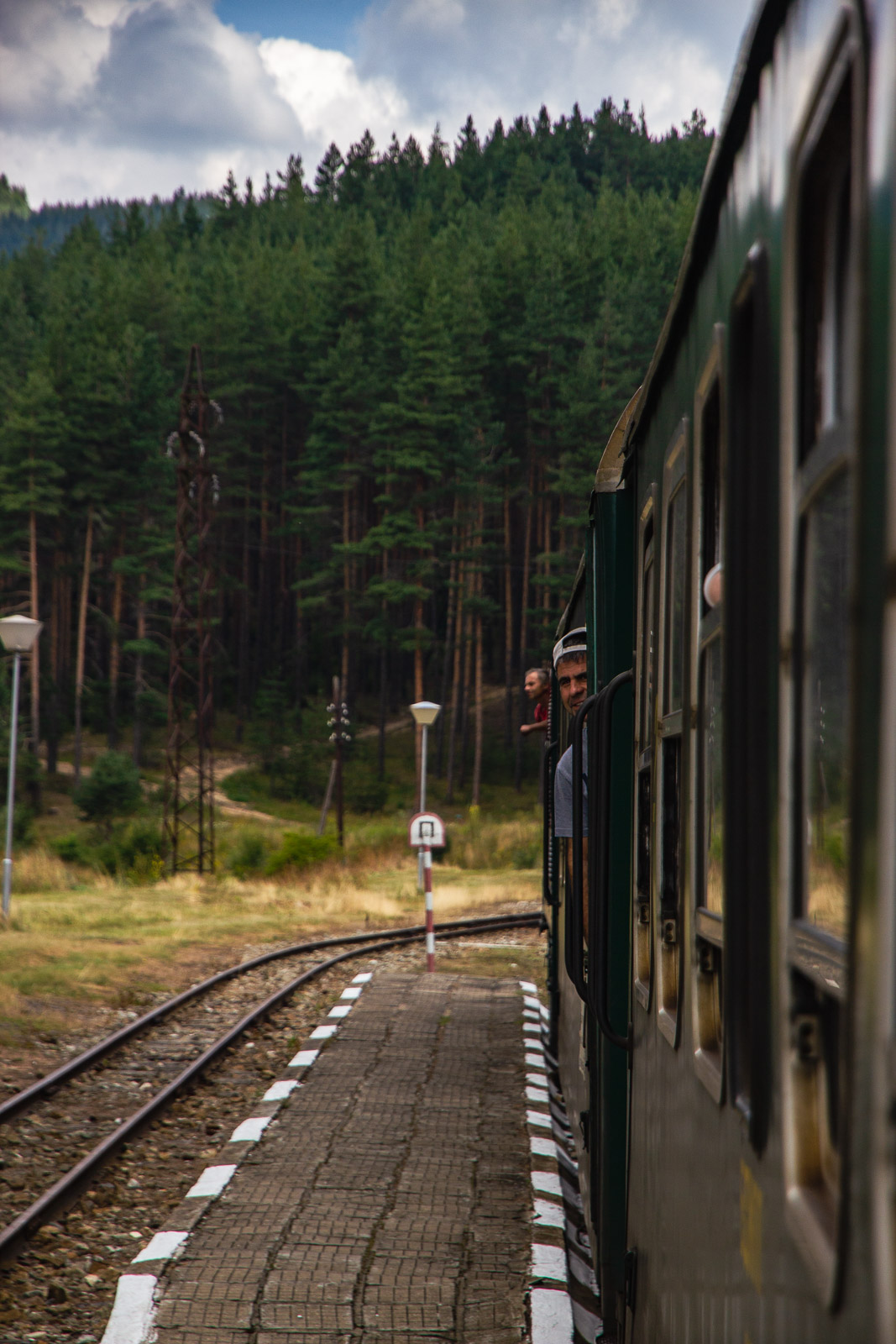
Now, let’s understand how Bulgarian railways timetables and ticket systems work – because that part of the experience deserves its own explanation.
Reading the Bulgarian train timetable
As of 2026, BDZ (Bulgarian State Railways) is still the only operator running passenger trains in the country. Until that changes, the entire Bulgaria rail network operates under a single timetable system, which makes route planning relatively straightforward.
You simply enter your departure and arrival stations, and the system displays all available Bulgaria trains for that route.
That said, it’s still useful to understand how the timetable works. The interface is fairly clear, but small details – like transfers, seat types, or hidden connection times – can change how convenient a journey actually is. And those details are easy to miss at first glance.
Fortunately, the current system is also the most reliable version BDZ has had so far.
To see how it works, let’s look at a typical example: traveling from Sofia to Ruse.
When you search this route, you’ll usually see several options. Two common ones might look something like this.
Example 1: Direct train
The first option is a direct train.
In most cases, this is the best choice. Direct trains are usually faster, simpler, and sometimes even cheaper than routes that require transfers. More importantly, they remove the risk of missing a connection somewhere along the way.
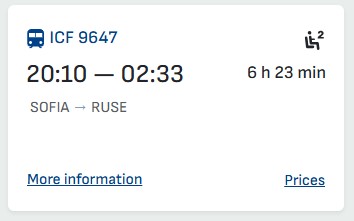
On the far left of the timetable you’ll see:
- Departure and arrival stations: Sofia → Ruse
- Departure and arrival times: for example 20:10 – 02:33
Next to that, the system shows several key details:
- Train type: for example Fast train
- Train number: for example 9647
- Total travel time: 6 hours 23 minutes
If you click on “More information” the system expands the details. In this case there are no surprises – the journey is exactly what it looks like.
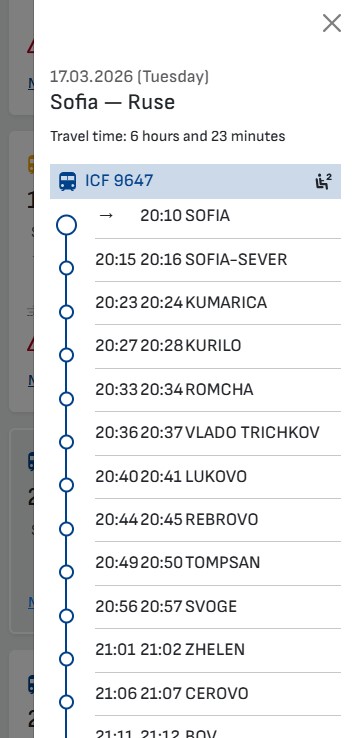
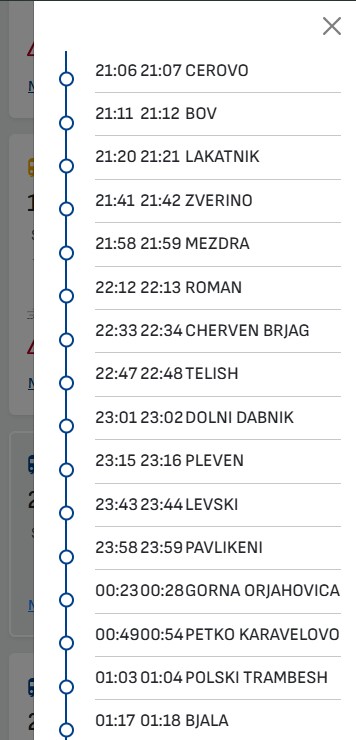
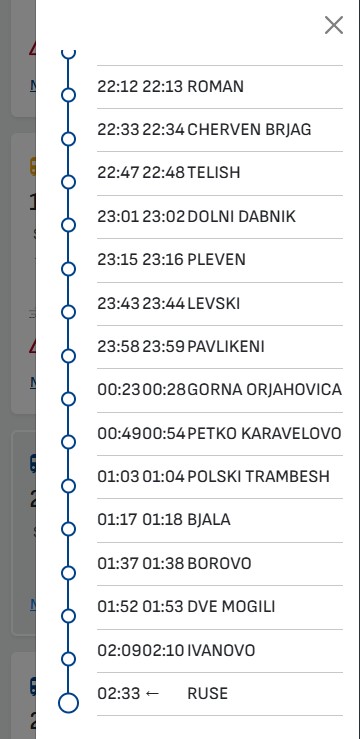
On the right side you’ll also see small icons. These indicate what type of seating is available on that particular train. In this example: 2nd class seating
Example 2: Train with a change
The second option is marked as the fastest but involves two transfers.
In this case, you would first travel from Sofia to Sofia Sever, switch trains to Gorna Oryahovitsa, then switch trains and continue from Gorna Oryahovitsa to Ruse.
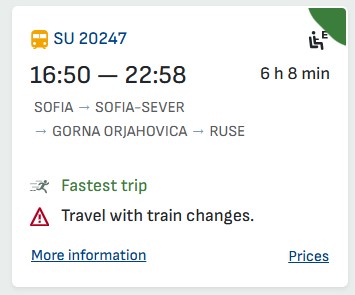
At first glance, the timetable only shows one train type and number, along with icons indicating Electric multiple unit train.
However, the important details appear once you click “More information”.
Now the system reveals the full journey.
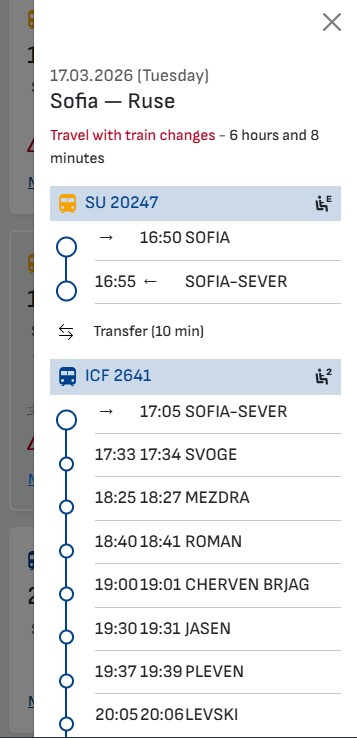
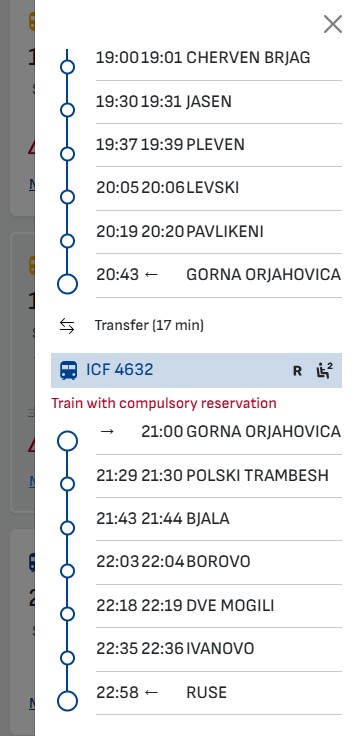
Now you see all train numbers and types, available seating types and all the stops and transfer waits.
In this example:
- You have 10 minutes to transfer to the second train
- The second train offers second-class seating only
- You have 17 minutes to transfer to the third train
- The third train offer second-class seating only and requires seat reservation
This is exactly why expanding the details matters. These are the kind of details you want to notice before buying the ticket – not when you arrive at a train station you’ve never been to before.
Train tickets
Buying tickets for Bulgaria trains is fairly straightforward. The most convenient option is usually purchasing them online through the BDZ system, which can save you a trip to the ticket counter.
However, the online platform still doesn’t include the full range of services available at BDZ ticket offices. Some special tickets, discounts, or more complex routes may still require buying in person.
For most standard journeys across the Bulgaria rail network, though, the online system works perfectly well.
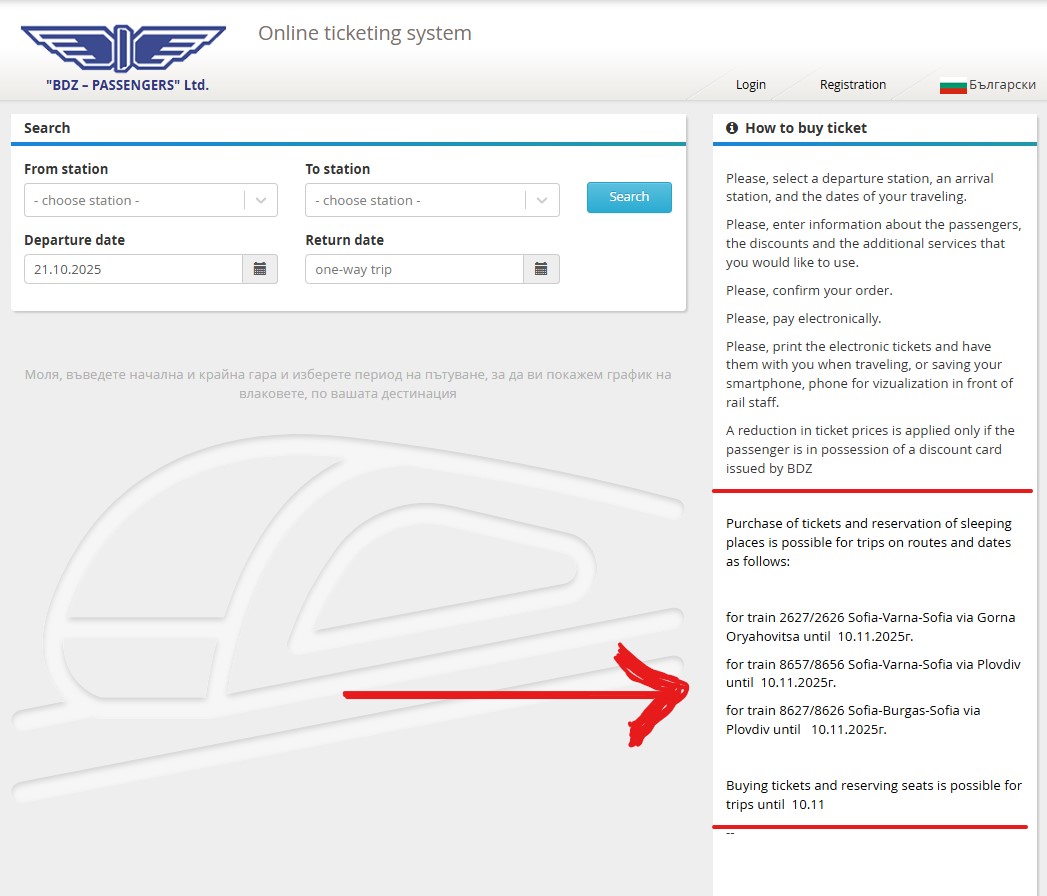
Online train tickets
Purchasing an online ticket
To purchase tickets online, use the official Bulgarian Railways booking platform: bileti.bdz.bg
The process is relatively simple and only takes a few minutes.
Step 1: Create an account
- Go to: bileti.bdz.bg/register
- Register for an account before booking your first ticket.
- Make sure the name you enter matches your ID document exactly, as this may be checked during ticket inspection. After registering, confirm your account using the verification email sent by BDZ.
Step 2: Search for your trip
- Visit bileti.bdz.bg and enter your: Departure station; Arrival station; Departure date; Return date (if needed)
- The system will show available Bulgaria trains for your route.
- You can book tickets for up to five passengers, but you’ll need to enter each passenger’s personal details during the process.
Step 3: Select travel details
- Choose your class of travel: 1st class; 2nd class; Sleeping cabin (if available)
- Then click “Choose Scheme” to open the seat map.
- Seats marked in white are available, and you can select your preferred one directly.
- It’s worth paying attention to your assigned seat. Some Bulgarian railways routes fill up quickly, and if you’re sitting in someone else’s reserved seat, they will usually ask you to move.
Step 4: Make the payment
- Proceed to payment and select BORIKA if you want to pay by card.
- There is also an ePay option, but this requires having an account registered on the ePay platform.
- Once payment is completed, your digital ticket will be issued through the system and can be shown during ticket inspection.
Using an online ticket
After purchasing a ticket through the Bulgarian Railways (BDZ) system, the ticket will be sent to your email and also appear in your account under the “Tickets” section on the BDZ website.
When boarding Bulgaria trains, you don’t need to print anything. The conductor will simply scan the ticket on your phone during inspection, so keep it accessible during the journey.
Cancelling an online ticket
If your plans change, you can cancel an unused ticket as long as it’s still within the allowed cancellation window.
The deadlines are:
- Up to 3 hours before departure for standard seat tickets
- Up to 24 hours before departure for sleeping cabin tickets
After that point, the ticket can no longer be cancelled.
To cancel your ticket in the system:
- Go to Profile → Tickets
- Select the ticket you want to cancel
- Click the “X – cancellation” button next to the printing option
- You’ll then see a confirmation message. Unfortunately, this message is not translated into English, but the process is simple – click “Send” to confirm the cancellation request.
- Once submitted, the refund will be processed by Bulgarian Railways and returned via bank transfer.
Refunds and cancellation fees
BDZ does not issue full refunds for cancelled tickets.
A 10% cancellation fee is deducted from the ticket price, and the seat reservation fee (around €0.50) is non-refundable.
Refunds are typically processed within 30 days after the cancellation is confirmed, so it may take some time before the amount appears in your bank account. This is normal for the BDZ ticket system and doesn’t usually indicate a problem with the request.
Tickets at the train station
You can always buy tickets for Bulgaria trains directly at a BDZ ticket office at the train station. This can be done either on the day of travel or in advance, depending on the route.
In some cases, buying at the station is actually the better option. The BDZ online system still doesn’t cover every ticket type available across the Bulgarian rail network.
One small complication involves sleeping cabins. Sometimes you cannot reserve them ahead of time and need to upgrade after boarding the train. The exact rules for when this applies are not always clear, so if a sleeper is important for your journey, it’s worth asking the staff at the ticket office.
You’ll need to buy your ticket at the station if:
- You want a return ticket with the standard BDZ discount
- You’re traveling internationally
- The train you need doesn’t appear in the online ticket system
- You’re traveling with a bicycle and need a bike pass
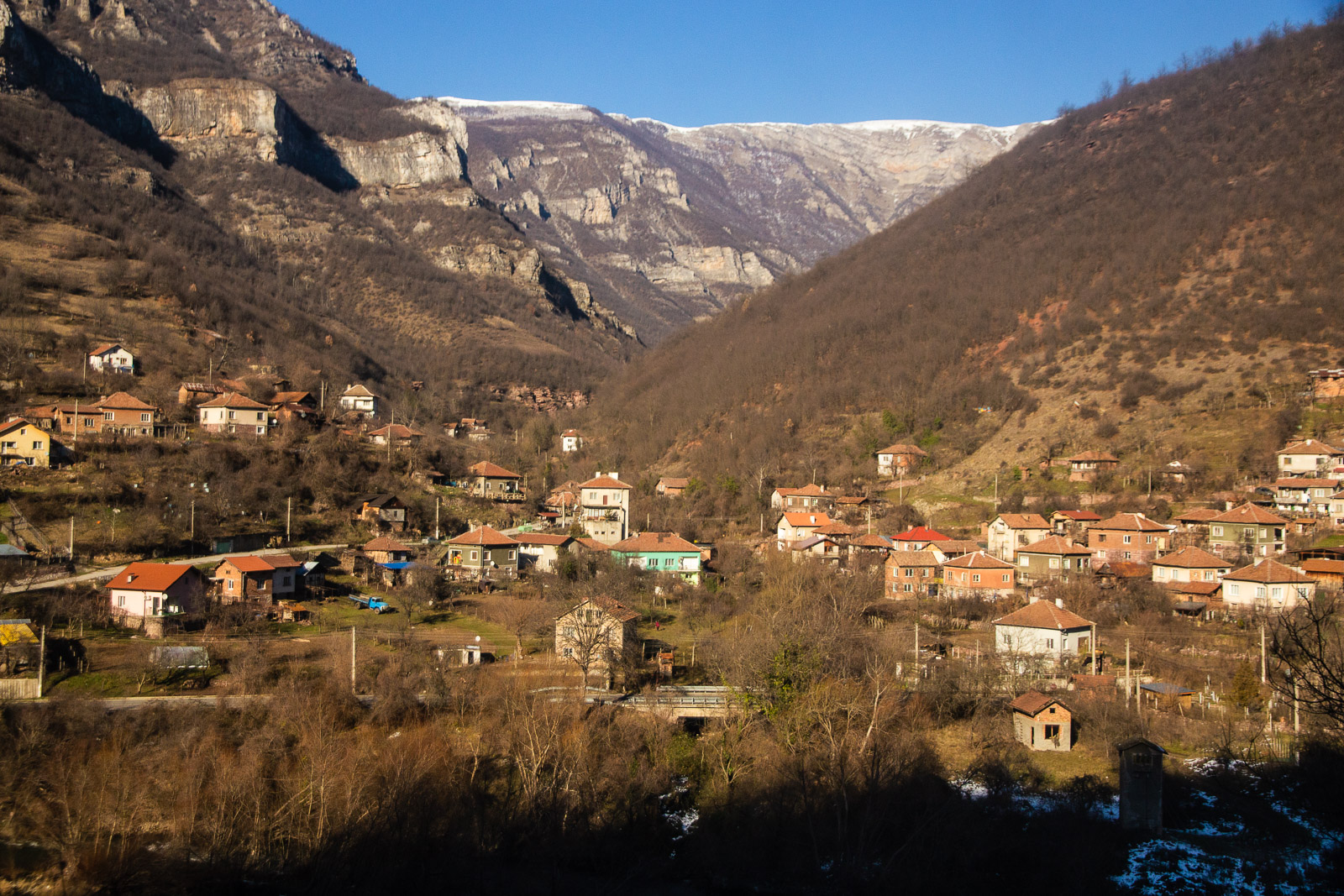
Tickets on the train
If none of the other options work, you can also buy a ticket directly on board.
This situation usually happens when you board at a small stop that doesn’t have a ticket office, which is fairly common on parts of the Bulgaria rail network.
In that case, the conductor who checks tickets will sell you one during inspection.
I’ve personally never had to do this, but it’s widely known that tickets purchased on the train can be slightly more expensive than buying them in advance. The difference is usually small – typically a couple of euros, not a major surcharge.
Tickets from a station machine
Some larger stations on the Bulgarian rail network also have self-service ticket machines.
These machines are fairly straightforward to use and include an English language option, which makes them a practical alternative if the ticket office is busy.
The process is simple:
- Enter your departure station, arrival station, and travel date
- Choose one-way or return ticket
- Select your preferred train
- Enter the number of passengers
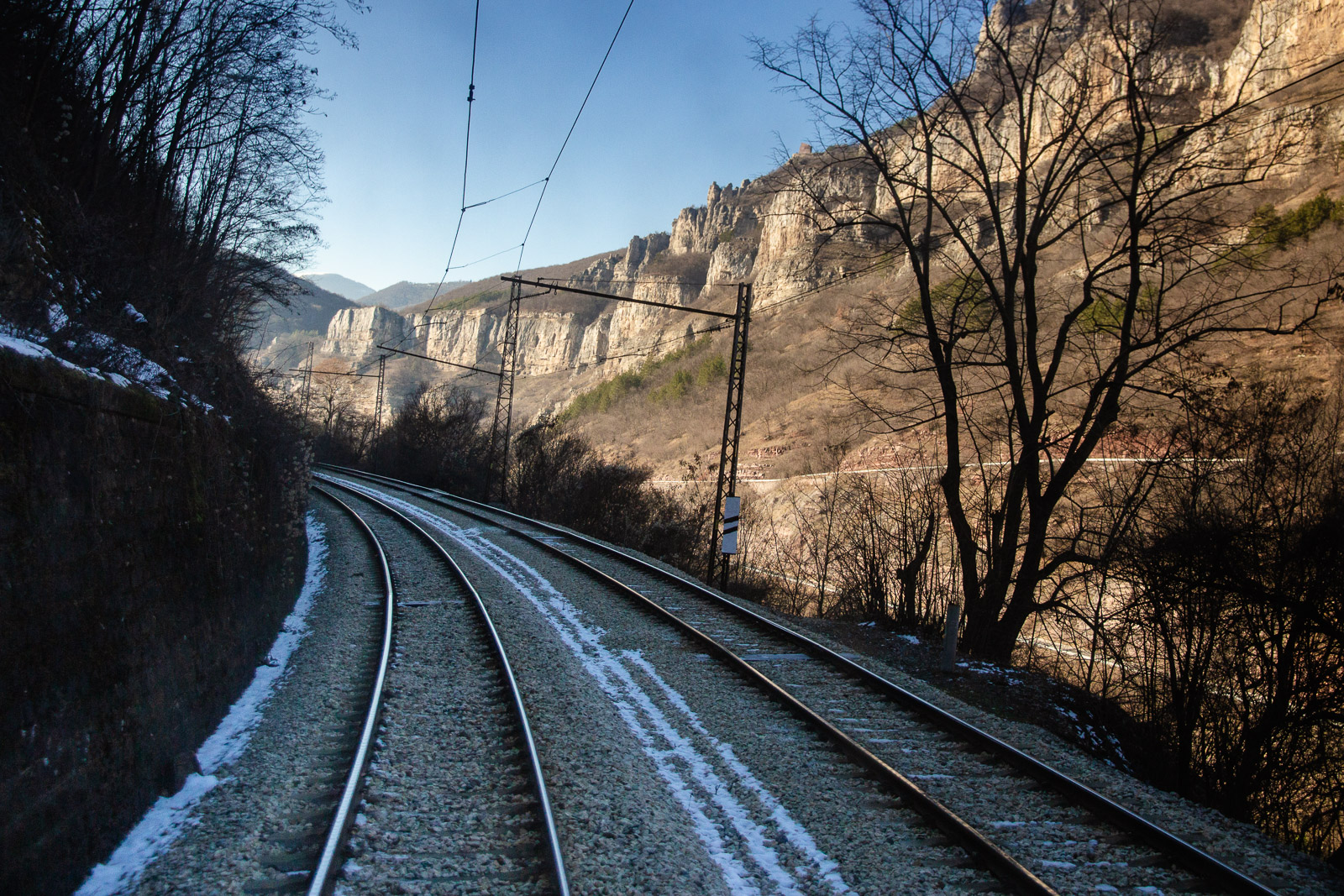
The machine will then display the final ticket price. After confirming your selection, you’ll have the option to enter any discount pass details if applicable.
Payment is made by credit or debit card, and the machine prints your ticket immediately.
Using international rail passes in Bulgaria
If you plan to travel mainly by train across the Bulgaria rail network, international rail passes can sometimes be a convenient option.
These passes are typically purchased through providers like Rail Europe, which distribute Eurail passes covering multiple European countries, including Bulgarian Railways (BDZ).
To check available passes:
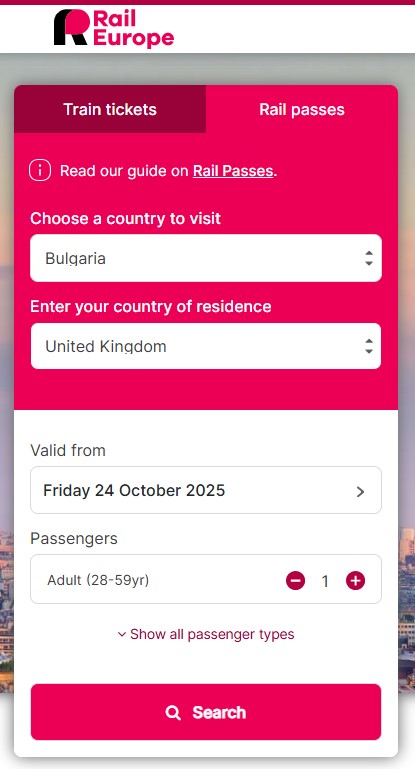
- Go to the Rail Europe website
- Open the Rail Passes section
- Select your destination country
- Enter your travel details (including your country of residence, travel dates, and number of passengers).
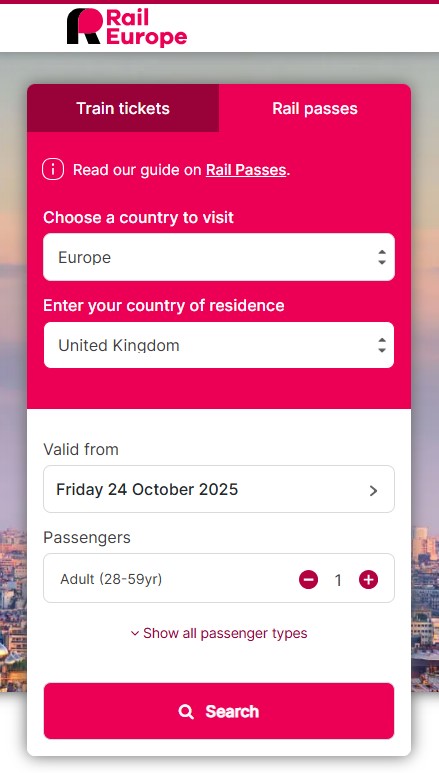
For Bulgaria trains, there are usually two relevant pass options.
Eurail Global Pass (multi-country)
The Eurail Global Pass allows travel across multiple European countries, including Bulgaria.
There are two main versions:
- Eurail Global Mobile Pass (Continuous) – This pass allows unlimited train travel during the validity period. Available durations typically include 15 or 22 days; 1, 2 or 3 months. This option makes sense if you plan to travel frequently across several countries.
- Eurail Global Mobile Pass (Flex) – The flexible version gives you a set number of travel days within a longer period. Example 1: 4, 5, or 7 travel days within 1 month; Example 2: 10 or 15 travel days within 2 months. You only activate a travel day when you actually take a train.
Both Global Pass options allow you to choose 1st or 2nd class.
Eurail Bulgaria Pass (single country)
If you plan to explore only Bulgaria by train, the Eurail Bulgaria Mobile Pass may be more practical.
This pass is valid for one month from the start date you select, and within that period you choose how many travel days you want: 3, 4, 5, 6 or 8 days.
Like the Global Pass, you can choose 1st or 2nd class.
Bulgaria rail network: where you can travel by train
The Bulgaria rail network is fairly extensive and connects most major cities and regional towns. That said, it doesn’t reach everywhere, so some destinations still require a bus or car for the final stretch.
Below you can see the official map of the Bulgarian railway infrastructure.
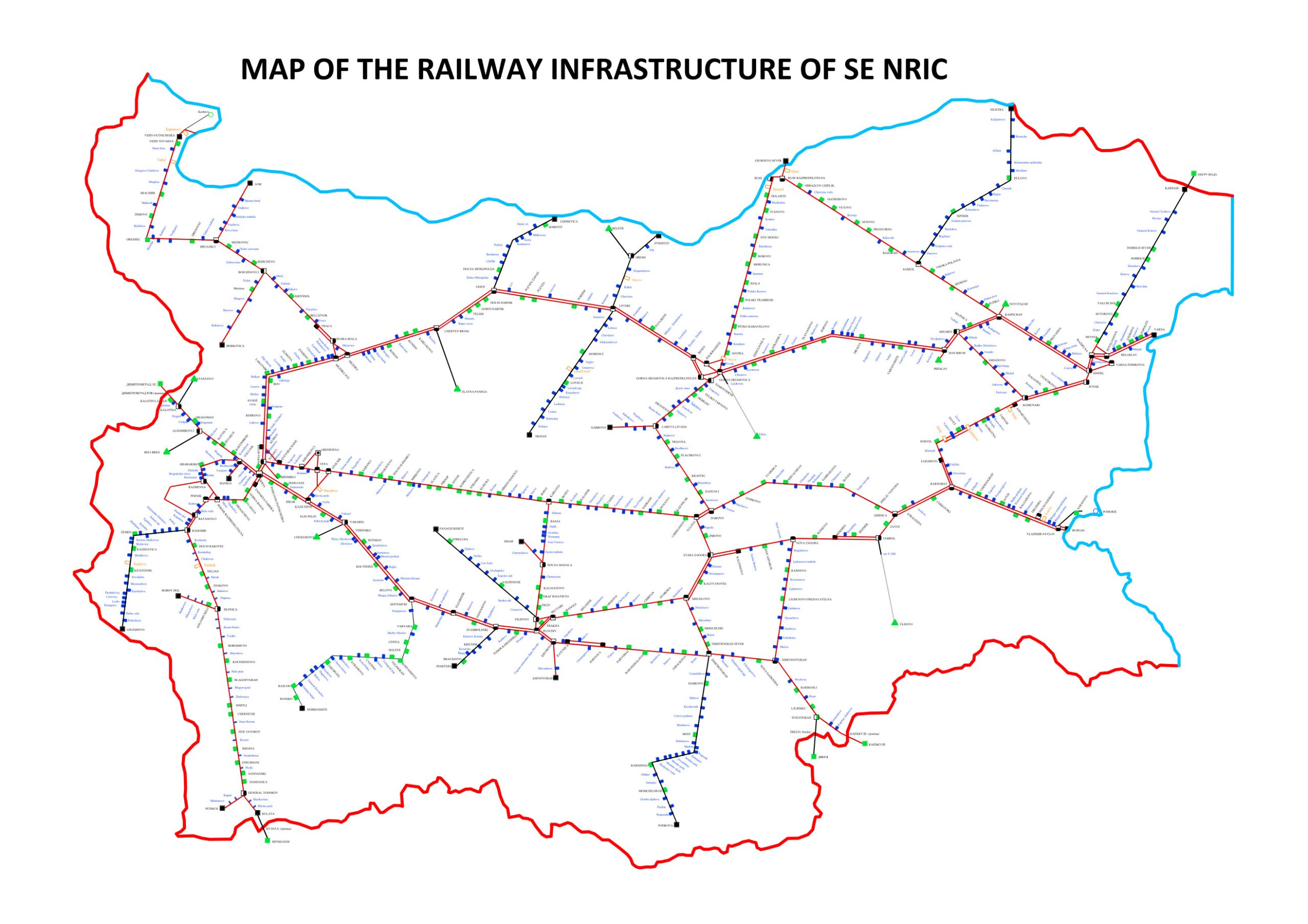
*Map of Bulgarian rail routes and infrastructure; Source: https://www.rail-infra.bg/en/12

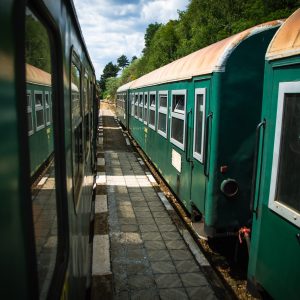
Bulgaria train travel
Traveling by train in Bulgaria is simple once you understand how the system works. This guide explains Bulgaria trains, ticket options, timetables, and the structure of the Bulgarian railways network so you can plan your trip without surprises.
Read More
13 things to do in Kyustendil
Planning a trip to Kyustendil? This guide covers what to see in the city and nearby - from Roman thermae and Ottoman-era baths to mountain hikes, giant sequoias, and Rila Monastery - with practical tips to help you plan independently.
Read More
Events in March 2026
Planning a trip to Bulgaria in February? From wine and food festivals to Kukeri carnivals and ancient rituals, this month is packed with local traditions and recurring events across the country. Here are 16 events and festivals in Bulgaria this February to help you plan beyond the usual tourist spots.
Read More
Osogovo Hut
Osogovo Hut isn't a typical Bulgarian mountain hut - it's got private bathrooms, unlimited water, and a restaurant with amazing food. This guide covers rooms, prices, hiking trails to Ruen Peak, and what makes it worth the short drive from Kyustendil.
Read More